Ependymal tumors are the third most common primary spinal tumor in adults, after meningiomas and peripheral nerve sheath tumors. WHO (World Health Organization) Grade II spinal ependymomas, like the one depicted on this sagittal MRI of the cervical spine, have a typical radiographical appearance featuring an intramedullary oval-shaped mass with contrast enhancement. Ependymomas are often... Continue Reading →
Fungal Encephalitis with Angioinvasion
Infection of the brain by fungal organisms, termed fungal encephalitis, is an uncommon, but deadly disease that tends to occur in persons with compromised immune systems or, as in this case, uncontrolled diabetes. Zygomycetes, a group of fungal organisms that includes Mucor and Rhizopus, has a particular proclivity to invade blood vessels (pictured here), which can... Continue Reading →
Arteriovenous Malformation
Arteriovenous malformation, or AVM, is a collection of abnormal vessels that lack an intervening capillary bed and are separated by gliotic brain tissue. Some vessels have thick walls with elastic laminae typical of arteries, while others have thin collagenous walls typical of veins. In addition, "arterialization of a vein" can also be seen in which... Continue Reading →
Mengioma: Vascular Changes and Prognosis
Meningiomas, like the one pictured here, typically show whorling architectural pattern and nuclear pseduoinclusions. The vast majority of meningiomas are low grade (WHO Grade 1) dura-based tumors with good prognosis following complete resection. However, recent studies have suggested that endothelial cell hypertrophy and/or microvascular proliferation in an otherwise typical meningioma are correlated with shorter progression free... Continue Reading →
Pilocytic Astrocytoma – Molecular testing to aid histologic diagnosis.
Pilocytic Astrocytoma (PA) characteristically exhibits biphasic morphology featuring densely fibrillar, compact regions alternating with loosely-cohesive microcystic or myxoid areas; the latter is pictured here. Diagnosis can be difficult, especially on small biopsies, but molecular testing can help. BRAF-KIAA1549 fusion occurs in about 70% of PAs, whereas BRAF V600E mutation occurs in about 5-10% of PAs.
Pilocytic Astrocytoma Cytology
Pilocytic astrocytoma is a circumscribed glioma (WHO Grade I) commonly found in children and young adults. Characteristic features include piloid cells with long, thin, hair-like cytoplasmic processes and a myxoid background, which are both seen here in this medium power image of a cytologic smear preparation performed during intraoperative consultation.
Atypical Meningioma – Mitoses and Macronucleoli
The vast majority of meningiomas are benign grade I tumors. Meningiomas can be upgraded to grade II, called atypical meningiomas, if they show increased mitotic activity (4 or more mitoses in 10 high power fields) or other worrisome histopathologic features, such as tumor cells exhibiting a prominent and large nucleolus. Notice the mitosis in the center-right of the image and... Continue Reading →
Reactive vs. Neoplastic Astrocytes
Astrocytes are star-shaped glial cells that comprise a large proportion of brain tissue. Non-neoplastic reactive astrocytes can sometimes be difficult to differentiate from the neoplastic astrocytes of glial tumors called astrocytomas. This GFAP stain highlights the key morphologic differences between the star-shaped and widely spread-out non-neoplastic reactive astrocytes compared to the neoplastic astrocytes in this glioblastoma, which exhibit crowding and severe variation in... Continue Reading →
Leptomeningitis and Perivascular Spread
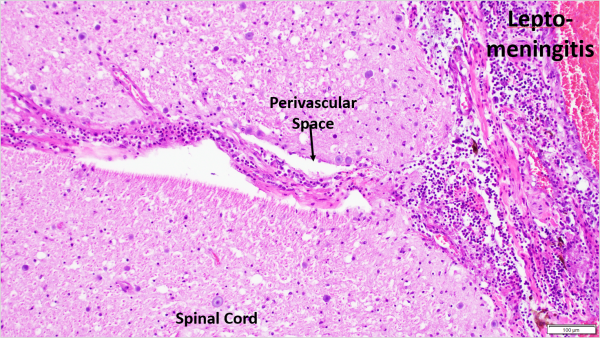
Many blood vessels that supply the brain and spinal cord initially run within the covering layers on the external surface, called the leptomeninges (also known as the pia-arachnoid), before plunging into the deeper neural tissue. As the vessel transitions from the outer layers into deeper tissue, the perivascular space immediately surrounding the vessel, called Virchow-Robin space, may provide a conduit for infectious/inflammatory processes. ... Continue Reading →
Infection/Inflammation of Spine and Nerve Roots
The spinal cord is covered by protective outer connective tissue layers called the pia-arachnoid or leptomeninges. Inflammatory or infectious processes that involve the leptomeninges, called leptomeningitis, can also involve the adjacent spinal nerve roots, which similarly have an outer covering of connective tissue that is continuous with the leptomeninges. The image depicts a spinal cord with acute... Continue Reading →