A review of common gross findings of acute traumatic brain injury (TBI), including a discussion of herniation types and contusional patterns. https://www.youtube.com/watch?v=vnPdJ77khgo&t=333s
Video: Acute Traumatic Brain Injury

A forum dedicated to the expansion in neuropathology knowledge for students and practitioners alike.
A review of common gross findings of acute traumatic brain injury (TBI), including a discussion of herniation types and contusional patterns. https://www.youtube.com/watch?v=vnPdJ77khgo&t=333s


Psammoma bodies, lamellated purple concretions composed of calcium and other ions, are commonly found in meningiomas and are particularly numerous in the psammomatous variant of meningioma, pictured here. Psammomatous meningiomas are low grade (WHO grade I) tumors that often have a gritty texture on gross evaluation due to increased numbers of psammoma bodies and dystrophic calcification often necessitating... Continue Reading →


Metastatic cancers (i.e. cancers that originate somewhere else and travel to the brain usually via the bloodstream) can occur singly or, as pictured here, as multiple lesions. Sometimes brain metastases represent the initial clue that the person has cancer somewhere else in the body, as was the case for this patient who was found to have three enhancing cerebral lesions... Continue Reading →


Although meningiomas are classically dura-based lesions, they can also arise in the choroid plexus and, thus, must be considered in the differential diagnosis for intraventricular lesions. This intraventricular meningioma, shown here, is growing underneath normal choroid plexus epithelium.

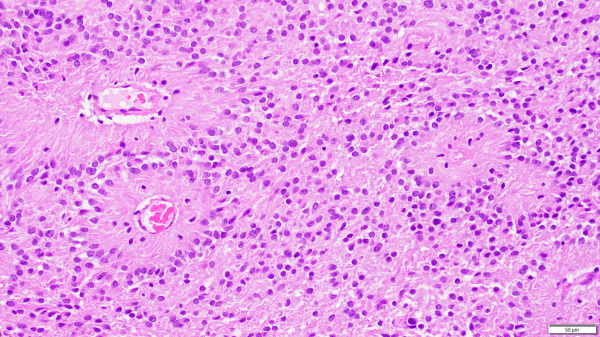
Ependymomas are glial tumors that commonly harbor perivascular pseudo-rosettes, seen here, characterized by radially arranged tumor cells around a blood vessel core. https://youtu.be/UXDIYV_yMro


The World Health Organization Classification of Tumors of the CNS officially recognizes 13 different variants of meningioma, most of which are Grade 1 tumors that are potentially curable with complete resection. Chordoid meningioma is a rare subtype that accounts for less than 1% of all intracranial meningiomas. They are commonly composed of epithelioid tumor cells,... Continue Reading →

 Adventures in Neuropathology