Pilocytic Astrocytoma Cytology

Pilocytic astrocytoma is a circumscribed glioma (WHO Grade I) commonly found in children and young adults. Characteristic features include piloid cells with long, thin, hair-like cytoplasmic processes and a myxoid background, which are both seen here in this medium power image of a cytologic smear preparation performed during intraoperative consultation.  

Atypical Meningioma – Mitoses and Macronucleoli

The vast majority of meningiomas are benign grade I tumors.  Meningiomas can be upgraded to grade II, called atypical meningiomas, if they show increased mitotic activity (4 or more mitoses in 10 high power fields) or other worrisome histopathologic features, such as tumor cells exhibiting a prominent and large nucleolus.  Notice the mitosis in the center-right of the image and... Continue Reading →

Reactive vs. Neoplastic Astrocytes

Astrocytes are star-shaped glial cells that comprise a large proportion of brain tissue.  Non-neoplastic reactive astrocytes can sometimes be difficult to differentiate from the neoplastic astrocytes of glial tumors called astrocytomas.  This GFAP stain highlights the key morphologic differences between the star-shaped and widely spread-out non-neoplastic reactive astrocytes compared to the neoplastic astrocytes in this glioblastoma, which exhibit crowding and severe variation in... Continue Reading →

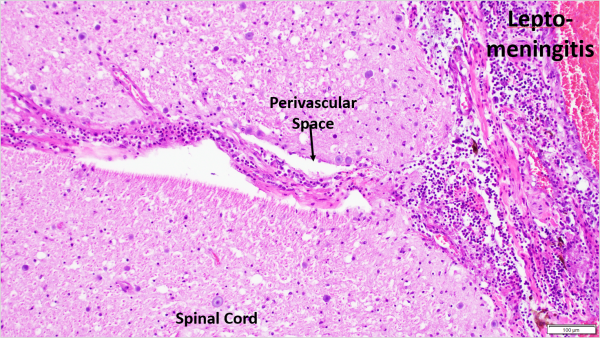
Leptomeningitis and Perivascular Spread

Many blood vessels that supply the brain and spinal cord initially run within the covering layers on the external surface, called the leptomeninges (also known as the pia-arachnoid), before plunging into the deeper neural tissue. As the vessel transitions from the outer layers into deeper tissue, the perivascular space immediately surrounding the vessel, called Virchow-Robin space, may provide a conduit for infectious/inflammatory processes. ... Continue Reading →

Infection/Inflammation of Spine and Nerve Roots

The spinal cord is covered by protective outer connective tissue layers called the pia-arachnoid or leptomeninges.  Inflammatory or infectious processes that involve the leptomeninges, called leptomeningitis, can also involve the adjacent spinal nerve roots, which similarly have an outer covering of connective tissue that is continuous with the leptomeninges.  The image depicts a spinal cord with acute... Continue Reading →

Subarachnoid Hemorrhage

Life-sustaining blood is supplied to the brain by blood vessels, many of which run within the arachnoid layer covering the external surface before plunging into the deeper brain tissue.  If the vessels are disturbed, either by trauma, infection, or other insults, blood may exit the vessel and collect in the subarachnoid space in a process called subarachnoid... Continue Reading →

Alzheimer Disease: Tau-Positive Neurofibrillary Tangles

Neurofibrillary tangles, like the one shown here, are composed of hyperphosphorylated tau proteins.  Intracellular neurofibrillary tangles and extracellular amyloid plaques comprise the two characteristic neuropathologic findings of Alzheimer Disease, the most common neurodegenerative disease associated with progressive memory loss.  This image was taken from an area of the brain that is often affected in Alzheimer Disease: the hippocampus, which is a... Continue Reading →

Epidermoid Cyst

Epidermoid cysts (pictured here with surrounding brain tissue) are histologically characterized by a thin layer of squamous epithelium similar to the epidermal lining the skin.  However, unlike skin (which sheds its outer layer of dead cells into the environment), the keratin debris of the sloughed-off upper layer of the epidermoid cyst build up within the cyst center resulting in... Continue Reading →

Giant Cell Glioblastoma and Granular Mitoses

Giant Cell Glioblastoma, also called magnocellular or monstrocellular glioblastoma, is characterized by atypical cells that are extremely large, especially when compared to the non-neoplastic inflammatory cells seen on the left side of the image.  The tumor has increased number of dividing cells, including typical mitotic figures (bottom left arrow) and atypical or granular mitoses (bottom... Continue Reading →

Tuberculosis with Caseating Granuloma

Tuberculosis, or TB, is characterized by the formation of granulomas that often have central necrosis, called caseous necrosis due to its cottage-cheese appearance on gross evaluation.  Caseating granulomas characteristically have central necrosis surrounded by an immediate layer of macrophages and inflammatory cells, which, in turn, are surrounded by proliferating fibroblasts.  This effort to contain the... Continue Reading →

Website Powered by WordPress.com.

Up ↑